Blunkett's Quest, but is he on drugs?
Alan Travis and Just Us | 22.11.2004 21:57 | Education | Health | Repression | London | World
The legislation is expected to introduce a new definition of "possession" of an illegal drug, making it an offence to have a certain amount in the bloodstream. This is likely to prove controversial - not least because some drugs, such as cannabis, can remain in the bloodstream for weeks.
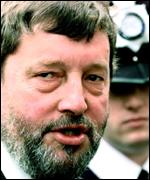
Blunkett to submit
to drug test to ensure
that he's not on drugs?
UK: Legislation will allow police to test suspects on arrest and make it an offence to have drugs in bloodstream?
New police powers to prosecute offenders for possession if they test positive for drugs when they are arrested, even if the only drugs they have are in their bloodstream, are to be announced this week.
The measure is part of legislation to be unveiled tomorrow in the Queen's speech alongside plans to introduce "identity cards" and set up a national agency to tackle serious and organised crime in Britain.
The home secretary, David Blunkett, confirmed yesterday that he was still looking at new anti-terror powers. He believed there was a "strong case" for judges in some terrorist trials to sit without a jury?
The proposals will be set out in a draft bill, but Mr Blunkett made it clear that they will not be introduced to parliament immediately. "It is not my intention to try and push a bill through this side of the general election, whenever the prime minister calls it," he said yesterday.
Instead, the government intends to make the drug bill one of five measures given priority in the next session of parliament.
It will contain a new power to perform drug tests on all those arrested whom the police suspect are problem drug users and a range of other measures to take advantage of the rapid expansion of drug-treatment programmes.
Tony Blair, who has insisted that the drug measures be introduced in a separate high-profile bill, hopes that, in the run-up to the election, he can make a massive expansion of drug-treatment programmes a key element in the government's drive to cut crime.
But what about a genes test to see if you should be arrested for bad genes?
Ministers have become frustrated that the reclassification of cannabis has eclipsed major investment in ensuring that at least 150,000 problem drug users are going through treatment every year. "We are doing a lot more to break the link between drugs and crime, particularly with intervention programmes, but you would not think so from the way the issue has been debated over the last 18 months," said a Home Office source.
At present, the police only have the power to insist that a person takes a drug test when they have been formally charged. The Home Office says that allowing the police to test those who have been arrested is likely to double the number who are tested in police stations to 240,000 a year.
The legislation is expected to introduce a new definition of "possession" of an illegal drug, making it an offence to have a certain amount in the bloodstream. This is likely to prove controversial - not least because some drugs, such as cannabis, can remain in the bloodstream for weeks?
That means they can come and get you out of bed anytime they like and lock you up for possession of what is inside your body? Very sad!
Why don't we all just go down the police station and lock ourselves up?
Makes me wonder how much room they have in the jail? Better still why don't we live in jails then they don't have to lock us up? We could privatise the prison and just buy a 12 by 6 cell or is that too lush?
In a move which is likely to alarm human rights lawyers, ministers are examining ways in which somebody who is the subject of an anti-social behaviour order can be compelled to go through a drug-treatment course even though they have not been convicted of a criminal offence.
Makes sense would someone describe anti-social behaviour? Is that like breaking the law in the UK or is it like if you look or act different?
It was my understanding that if you broke the law of the land you were charged with an offence but it seems in the UK if you're less able to be social then you broke the law even when no crime has been committed, even if you lack social skills because your weren't educated, or if this legislation is adopted even if you had a party drug 6 weeks ago?
Why not anti moral behaviour if you lie? Why not anti-health behaviour if you don't wash your hands before you cook dinner? I guess my understanding of the law is too narrow?
Mr Blunkett told ITV1's Jonathan Dimbleby programme that decisions on new anti-terror laws could not be taken until the House of Lords had ruled on the legality of the detention of foreign nationals at Belmarsh.
Related:
Categories of Surveillance
In 1998, The Macmillan Atlas Of The Future predicted the levels of surveillance that would apply throughout the world in 2003. They categorised the levels of citizen watching according to the following scale.
* (Z) "Total Surveillance"
"Comprehensive, co-ordinated surveillance of lifestyle, movement, friendships, sexual and political activities, religious practices, and other data collected and processed without legal or constitutional protections."
* (Y) "Mass Surveillance"
"Comprehensive, co-ordinated surveillance with legal and/or constitutional protections."
* (X) "High-Density Surveillance"
"Selective co-ordinated surveillance of large numbers of people using limited technological infrastructure."
* (W) "Medium Density Surveillance"
"Medium density surveillance in law enforcement, taxation, government benefits, credit reporting and financial institutions with limited legal and/or constitutional protections."
* (V) "Moderate Surveillance"
"Moderate surveillance with adequate protections."
If you take a straw poll among the citizens of Western nations, such as the USA, Britain, and Australia (the so-called Coalition of the Willing, in their "War against Terror") you are most likely to find that people believe that they are presently living under conditions of W or V category surveillance. If you try the question on people you know, use the full descriptions rather than the category headings as the basis. You will find that general perceptions of surveillance levels: at work, at home, in the street, at the seaside, and in restaurants, theatres and airline lounges, are quite moderate. The reality is very different.
Predicted Surveillance Outcomes - 2003
Although the predictions of The Macmillan Atlas Of The Future could be expected to have a degree of bias, due to the predominantly Western origins of the sources used, they presented an interesting picture. It is no surprise that the countries that were expected to have category Z levels of surveillance by 2003 include such "evil" places as: China, North Korea, Myanmar, Afghanistan, Iran, Iraq, Yemen, Libya, Algeria, Morocco, Nigeria, Angola, Namibia, Mozambique, Uganda, Colombia, Nicaragua, and Cuba.
What will surprise many people is that only three countries in the world, Canada, Japan, and New Zealand, were expected to fit into category V, moderate surveillance, where most citizens in the West think their society would rate.
Countries such as the USA, Britain, Australia, Thailand, Malaysia, South Africa, Portugal, France, Germany, Switzerland, Belgium, the Netherlands, Denmark, Sweden, Norway, Finland, Austria, Croatia, and Greenland, were all expected to fit the mass surveillance category. That (Y) level involves comprehensive surveillance of all transactions, communications and movements, with some balance of human rights maintained by the existence of legal or constitutional protections. Mass surveillance means that everything is actually watched or is likely to be watched at the whim of one or more of the covert agencies of government.
In the West, Actual Surveillance Levels Are Higher Than Forecast
As a direct consequence of the 911 event and the subsequent "war on terror", the surveillance levels in many countries have been raised to new heights. At the same time legal and other protections have been removed, in the name of protecting "the public interest." The USA, Britain, and Australia are among the group of countries that have enacted or are proposing to enact new laws that give a wide range of government agencies new rights of surveillance, as well as entry without warrants and detention of suspects without trail or access to lawyers or human rights organisations. There is a growing need for widespread rebuttal of restrictions of freedom and invasions of privacy in the so-called representative democracies of the West.
In the West, New Technologies Enable Mass Surveillance
Some totalitarian states, such as Cuba, still rely heavily on informers and non-technical methods of surveillance. Other regimes employ a mix of technical and non-technical methods. In the West, less use is made of informers. While various overt police forces continue to maintain liaison with connections in organised crime circles, most government agencies now use a range of new technologies to spy on individuals and all manner of organisations. Despite pretenses of safeguards, such as the process that law enforcement agencies go through to obtain independent judicial approval for telephone intercepts, the fact is that all electronic conversations are recorded, all e-mails are captured, and many of the face-to-face voice communications in everyday life are also recorded and analysed for key words and voice recognition patterns.
Many of the technologies to make this possible have existed publicly for more than three decades, and it should be no surprise to anyone that they are being vigorously applied by covert government agencies. Other technologies are the products of "black budget" development projects and are still secret, although the broad characteristics of some of these have been leaked to the world at large. While their original purpose might have been military, the new technologies developed in secret projects are also available for industrial espionage, and for keeping a detailed watch on the activities of activist organisations, such as Greenpeace and Amnesty International.
Western Agencies Continually Spy On Other Regions Of The World
Citizens and business executives in Asia, Africa, South America, and much of Europe are continually spied on by Western intelligence agencies. This surveillance is not for military of political purposes, although those areas are also covered by other sections. The purpose of surveillance of ordinary citizens and business people is largely for economic advantage. Since the end of the Cold War between the US and the Soviets, the justification for covert agencies continuing to expand their operations had been mainly commercial. Thus, the details of a rival bid for a major construction or telecommunications project in Indonesia or Malaysia might be gathered in the intelligence net spread over the area by the US and Australia. Once they know details of rival bids by local consortiums, or possibly joint ventures between local companies and others from Europe, who are not part of the AMIC (American Military Industrial Complex) or its allies, US or Australian bidders might gain an important advantage. Such advantages can be increased if the intelligence gathered helps those firms being assisted by AMIC to identify points of leverage in the local society. In this context leverage refers to a basis for obtaining compliance. Surveillance might have revealed some sexual or financial improprieties, or a predisposition to corruption and the acceptance of bribes. On the other hand, there might be religious or moral views that can be exploited by, say, smearing the competition's reputation in certain ways.
The Legacy Of J Edgar Hoover
The use of positions of privilege in law enforcement and intelligence services, with unique access to covert surveillance information about the indiscretions of high profile members of society, is now commonplace. One of the most reported and best authenticated cases is that of J. Edgar Hoover, who headed the US Federal Bureau of Investigation (FBI) for 50 years. Hoover showed how easy it is, for those who hold surveillance technologies and capabilities, to capture a democracy. Once he set the FBI on the path of collecting unauthorised dossiers on elected representatives, judges, coroners, business tycoons, movie stars, and influential people in many other walks of life, the centre of power in the US shifted forever. It moved from the elected and accountable representatives and officials, who are visible and contactable, to unelected, non-accountable entities, who are invisible and anonymous.
Few Modern Governments Pass The Key Tests Of Democracy
Most political theorists concede that present forms of democracy are not true to the original principles established by the ancient Greeks. The Greek's key notion of democracy was that the people were in control. In the 18th century, Jean-Jacques Rousseau argued that sovereignty cannot ever be represented. In his view, elected deputies could never finally decide anything. The ideal society, he argued, is one in which the citizens are directly involved in the creation of the laws that govern them. However, this only happens in tribal societies. In modern federations, citizens elect career politicians to represent their individual interests, then the majority party makes laws and decisions "in the public interest". In a large federation, such as the USA, individual and local interests are typically subsumed by the "national interest". The latter is whatever the Feds, and any unseen forces that have gained sway over them, argue it to be.
Since the people no longer have any way of knowing who is ultimately determining what is "good" for the nation, the system can't be termed a democracy. (In ancient Greek, dëmos means people.) This situation of "non-democracy" applies in all federations and nations where the people are on the outside of the decision making processes, and where there are covert agencies actively spying on them, in the "national interest".
People: 'Prisoners' of Drugs'
According to an Australian Medical Association report, 83% of prisoners behind bars are there as a result of drug-related offences. In a NSW study it showed the frequent amount of burglaries depended on the rate of spending money on drugs. Neil Comrie, Victorian Poice estimates 70% of all criminal activity is drug related. Inadequate treatment services as well as treatment of drug addiction as a crime, rather than a health issue has criminalised a huge number of people.
More: http://melbourne.indymedia.org/news/2004/11/83215.php
to drug test to ensure
that he's not on drugs?
UK: Legislation will allow police to test suspects on arrest and make it an offence to have drugs in bloodstream?
New police powers to prosecute offenders for possession if they test positive for drugs when they are arrested, even if the only drugs they have are in their bloodstream, are to be announced this week.
The measure is part of legislation to be unveiled tomorrow in the Queen's speech alongside plans to introduce "identity cards" and set up a national agency to tackle serious and organised crime in Britain.
The home secretary, David Blunkett, confirmed yesterday that he was still looking at new anti-terror powers. He believed there was a "strong case" for judges in some terrorist trials to sit without a jury?
The proposals will be set out in a draft bill, but Mr Blunkett made it clear that they will not be introduced to parliament immediately. "It is not my intention to try and push a bill through this side of the general election, whenever the prime minister calls it," he said yesterday.
Instead, the government intends to make the drug bill one of five measures given priority in the next session of parliament.
It will contain a new power to perform drug tests on all those arrested whom the police suspect are problem drug users and a range of other measures to take advantage of the rapid expansion of drug-treatment programmes.
Tony Blair, who has insisted that the drug measures be introduced in a separate high-profile bill, hopes that, in the run-up to the election, he can make a massive expansion of drug-treatment programmes a key element in the government's drive to cut crime.
But what about a genes test to see if you should be arrested for bad genes?
Ministers have become frustrated that the reclassification of cannabis has eclipsed major investment in ensuring that at least 150,000 problem drug users are going through treatment every year. "We are doing a lot more to break the link between drugs and crime, particularly with intervention programmes, but you would not think so from the way the issue has been debated over the last 18 months," said a Home Office source.
At present, the police only have the power to insist that a person takes a drug test when they have been formally charged. The Home Office says that allowing the police to test those who have been arrested is likely to double the number who are tested in police stations to 240,000 a year.
The legislation is expected to introduce a new definition of "possession" of an illegal drug, making it an offence to have a certain amount in the bloodstream. This is likely to prove controversial - not least because some drugs, such as cannabis, can remain in the bloodstream for weeks?
That means they can come and get you out of bed anytime they like and lock you up for possession of what is inside your body? Very sad!
Why don't we all just go down the police station and lock ourselves up?
Makes me wonder how much room they have in the jail? Better still why don't we live in jails then they don't have to lock us up? We could privatise the prison and just buy a 12 by 6 cell or is that too lush?
In a move which is likely to alarm human rights lawyers, ministers are examining ways in which somebody who is the subject of an anti-social behaviour order can be compelled to go through a drug-treatment course even though they have not been convicted of a criminal offence.
Makes sense would someone describe anti-social behaviour? Is that like breaking the law in the UK or is it like if you look or act different?
It was my understanding that if you broke the law of the land you were charged with an offence but it seems in the UK if you're less able to be social then you broke the law even when no crime has been committed, even if you lack social skills because your weren't educated, or if this legislation is adopted even if you had a party drug 6 weeks ago?
Why not anti moral behaviour if you lie? Why not anti-health behaviour if you don't wash your hands before you cook dinner? I guess my understanding of the law is too narrow?
Mr Blunkett told ITV1's Jonathan Dimbleby programme that decisions on new anti-terror laws could not be taken until the House of Lords had ruled on the legality of the detention of foreign nationals at Belmarsh.
Related:
Categories of Surveillance
In 1998, The Macmillan Atlas Of The Future predicted the levels of surveillance that would apply throughout the world in 2003. They categorised the levels of citizen watching according to the following scale.
* (Z) "Total Surveillance"
"Comprehensive, co-ordinated surveillance of lifestyle, movement, friendships, sexual and political activities, religious practices, and other data collected and processed without legal or constitutional protections."
* (Y) "Mass Surveillance"
"Comprehensive, co-ordinated surveillance with legal and/or constitutional protections."
* (X) "High-Density Surveillance"
"Selective co-ordinated surveillance of large numbers of people using limited technological infrastructure."
* (W) "Medium Density Surveillance"
"Medium density surveillance in law enforcement, taxation, government benefits, credit reporting and financial institutions with limited legal and/or constitutional protections."
* (V) "Moderate Surveillance"
"Moderate surveillance with adequate protections."
If you take a straw poll among the citizens of Western nations, such as the USA, Britain, and Australia (the so-called Coalition of the Willing, in their "War against Terror") you are most likely to find that people believe that they are presently living under conditions of W or V category surveillance. If you try the question on people you know, use the full descriptions rather than the category headings as the basis. You will find that general perceptions of surveillance levels: at work, at home, in the street, at the seaside, and in restaurants, theatres and airline lounges, are quite moderate. The reality is very different.
Predicted Surveillance Outcomes - 2003
Although the predictions of The Macmillan Atlas Of The Future could be expected to have a degree of bias, due to the predominantly Western origins of the sources used, they presented an interesting picture. It is no surprise that the countries that were expected to have category Z levels of surveillance by 2003 include such "evil" places as: China, North Korea, Myanmar, Afghanistan, Iran, Iraq, Yemen, Libya, Algeria, Morocco, Nigeria, Angola, Namibia, Mozambique, Uganda, Colombia, Nicaragua, and Cuba.
What will surprise many people is that only three countries in the world, Canada, Japan, and New Zealand, were expected to fit into category V, moderate surveillance, where most citizens in the West think their society would rate.
Countries such as the USA, Britain, Australia, Thailand, Malaysia, South Africa, Portugal, France, Germany, Switzerland, Belgium, the Netherlands, Denmark, Sweden, Norway, Finland, Austria, Croatia, and Greenland, were all expected to fit the mass surveillance category. That (Y) level involves comprehensive surveillance of all transactions, communications and movements, with some balance of human rights maintained by the existence of legal or constitutional protections. Mass surveillance means that everything is actually watched or is likely to be watched at the whim of one or more of the covert agencies of government.
In the West, Actual Surveillance Levels Are Higher Than Forecast
As a direct consequence of the 911 event and the subsequent "war on terror", the surveillance levels in many countries have been raised to new heights. At the same time legal and other protections have been removed, in the name of protecting "the public interest." The USA, Britain, and Australia are among the group of countries that have enacted or are proposing to enact new laws that give a wide range of government agencies new rights of surveillance, as well as entry without warrants and detention of suspects without trail or access to lawyers or human rights organisations. There is a growing need for widespread rebuttal of restrictions of freedom and invasions of privacy in the so-called representative democracies of the West.
In the West, New Technologies Enable Mass Surveillance
Some totalitarian states, such as Cuba, still rely heavily on informers and non-technical methods of surveillance. Other regimes employ a mix of technical and non-technical methods. In the West, less use is made of informers. While various overt police forces continue to maintain liaison with connections in organised crime circles, most government agencies now use a range of new technologies to spy on individuals and all manner of organisations. Despite pretenses of safeguards, such as the process that law enforcement agencies go through to obtain independent judicial approval for telephone intercepts, the fact is that all electronic conversations are recorded, all e-mails are captured, and many of the face-to-face voice communications in everyday life are also recorded and analysed for key words and voice recognition patterns.
Many of the technologies to make this possible have existed publicly for more than three decades, and it should be no surprise to anyone that they are being vigorously applied by covert government agencies. Other technologies are the products of "black budget" development projects and are still secret, although the broad characteristics of some of these have been leaked to the world at large. While their original purpose might have been military, the new technologies developed in secret projects are also available for industrial espionage, and for keeping a detailed watch on the activities of activist organisations, such as Greenpeace and Amnesty International.
Western Agencies Continually Spy On Other Regions Of The World
Citizens and business executives in Asia, Africa, South America, and much of Europe are continually spied on by Western intelligence agencies. This surveillance is not for military of political purposes, although those areas are also covered by other sections. The purpose of surveillance of ordinary citizens and business people is largely for economic advantage. Since the end of the Cold War between the US and the Soviets, the justification for covert agencies continuing to expand their operations had been mainly commercial. Thus, the details of a rival bid for a major construction or telecommunications project in Indonesia or Malaysia might be gathered in the intelligence net spread over the area by the US and Australia. Once they know details of rival bids by local consortiums, or possibly joint ventures between local companies and others from Europe, who are not part of the AMIC (American Military Industrial Complex) or its allies, US or Australian bidders might gain an important advantage. Such advantages can be increased if the intelligence gathered helps those firms being assisted by AMIC to identify points of leverage in the local society. In this context leverage refers to a basis for obtaining compliance. Surveillance might have revealed some sexual or financial improprieties, or a predisposition to corruption and the acceptance of bribes. On the other hand, there might be religious or moral views that can be exploited by, say, smearing the competition's reputation in certain ways.
The Legacy Of J Edgar Hoover
The use of positions of privilege in law enforcement and intelligence services, with unique access to covert surveillance information about the indiscretions of high profile members of society, is now commonplace. One of the most reported and best authenticated cases is that of J. Edgar Hoover, who headed the US Federal Bureau of Investigation (FBI) for 50 years. Hoover showed how easy it is, for those who hold surveillance technologies and capabilities, to capture a democracy. Once he set the FBI on the path of collecting unauthorised dossiers on elected representatives, judges, coroners, business tycoons, movie stars, and influential people in many other walks of life, the centre of power in the US shifted forever. It moved from the elected and accountable representatives and officials, who are visible and contactable, to unelected, non-accountable entities, who are invisible and anonymous.
Few Modern Governments Pass The Key Tests Of Democracy
Most political theorists concede that present forms of democracy are not true to the original principles established by the ancient Greeks. The Greek's key notion of democracy was that the people were in control. In the 18th century, Jean-Jacques Rousseau argued that sovereignty cannot ever be represented. In his view, elected deputies could never finally decide anything. The ideal society, he argued, is one in which the citizens are directly involved in the creation of the laws that govern them. However, this only happens in tribal societies. In modern federations, citizens elect career politicians to represent their individual interests, then the majority party makes laws and decisions "in the public interest". In a large federation, such as the USA, individual and local interests are typically subsumed by the "national interest". The latter is whatever the Feds, and any unseen forces that have gained sway over them, argue it to be.
Since the people no longer have any way of knowing who is ultimately determining what is "good" for the nation, the system can't be termed a democracy. (In ancient Greek, dëmos means people.) This situation of "non-democracy" applies in all federations and nations where the people are on the outside of the decision making processes, and where there are covert agencies actively spying on them, in the "national interest".
People: 'Prisoners' of Drugs'
According to an Australian Medical Association report, 83% of prisoners behind bars are there as a result of drug-related offences. In a NSW study it showed the frequent amount of burglaries depended on the rate of spending money on drugs. Neil Comrie, Victorian Poice estimates 70% of all criminal activity is drug related. Inadequate treatment services as well as treatment of drug addiction as a crime, rather than a health issue has criminalised a huge number of people.
More:
http://melbourne.indymedia.org/news/2004/11/83215.php
Alan Travis and Just Us
 e-mail:
gkable@hotmail.com
e-mail:
gkable@hotmail.com
 Homepage:
http://www.geocities.com/nswac14/opinions3
Homepage:
http://www.geocities.com/nswac14/opinions3







Comments
Display the following comment