Blockading the G8: personal accounts
rask | 13.07.2005 19:15 | G8 2005 | Globalisation | Social Struggles | Liverpool
Account of the various blockades that took place on wednesday 5th, the first day of the G8 conference. It describes the different actions that took place around Scotland and includes analysis of tactics:
The disruption caused by blockades during the opening day of this years
G8 Summit was so massive, that entire delegations canceled their
arrivals, or were delayed until the late afternoon. What follows is a
compilation of first person accounts of the day, and information from
inside sources. We also include some preliminary analysis of blockading
tactics. The site of the summit. the Gleneagles golf resort, was chosen
in the belief that its isolation would prevent effective protest. In
the end, its isolation proved a liability, as protesters emerged from
the surrounding forests and hills, forcing the police into unfamiliar
territory, and outmaneuvering them until the roads of Scotland were
paralyzed.
Protesters were spread over three convergence centers -- one in
Edinburgh, one in Glasgow, and a rural ecovillage close to Gleneagles.
While this made communication between us difficult, it also spread the
resources of the police to the breaking point. Due to massive
incompetence, the police were mistakenly convinced that Edinburgh would
be the focus of the blockades, and sent most of their forces there.
There decision appears to have been based on advice from the London
police force, whose personal obsession with some of the individuals
staying in the urban convergence spaces (members of the London-based
Wombles) made them blind to what everyone else was planning.
Those at the ecovillage planned to stage a number of blockades on the
roads surrounding Gleneagles. There were two public blockading
actions which had been proposed by different groups and consented to on by
the ecovillage spokescouncil -- a blockade of the A9 (the primary
motorcade route of the delegates and staff), and another of the M9, a
strategic point within walking distance of the ecovillage. A car convoy
and critical mass bike ride were to serve as flying blockades.
The big difficulty we faced was that the ecovillage was easy for the
police to seal off (all other previous site locations had fallen through
following pressure on landowners by the police). The A9 was also an
eight hour hike from the ecovillage. This didn't deter us. Groups had
to leave the ecovillage well before the blockades, due to go up the
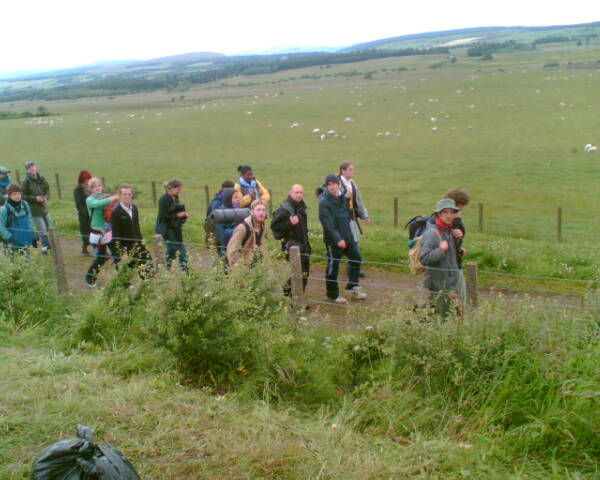
morning of July 6th. On the morning of July 5th, small groups of people
dotted the ecovillage, sitting in circles around maps and planning their
blockades. Throughout the day, groups would approach the action
transport tent, and ask to get taken to their sleeping location. Others
just starting walking over the hills towards Gleneagles. As darkness
fell, most of the inhabitants of the ecovillage were scattered in the
hills and forests around Gleneagles. By the time the police realised
what was happening, it was too late. They set up a security cordon
around the camp on the evening of the 5th, but by then, we were already
in the hills.
A9 blockade
At midnight, beacons of dissent were lit on the top of two of the
tallest hills surrounding Gleneagles. Such fire beacons had been used
for centuries in Scotland as a warning of impending invasion. The
beacons strengthened the resolve of those of us who saw them. We had
been walking through the woods in pouring rain, slowly making our way
towards our blockade location. Overhead, helicopters would eerily
hover, some with massive search lights, and others with heat sensing
cameras. Each time one flew over, we would run under trees, and huddle
into a compact pile, so that the police wouldn't be able to count how
many of us there were.
We arrived close to our blockade point in time to catch an hour or two
of sleep. We were soaked by the rain, and cold, but we knew that
throughout the forest, there were other small groups just like ours,
waiting to take the motorcade route at dawn. At 7 a.m., we struck,
dragging branches onto the A9, and quickly forcing a line of cars and
trucks to a halt. We were a small group of around 40, but we were one
of many such groups all of whom took the A9 at a number of different
locations between the towns of Greenloaning and Blackford. The dispersed
nature of our blockade meant that the police had to be spread all along
the road, and due to the blockades, they had difficulty moving from one
location to the other.
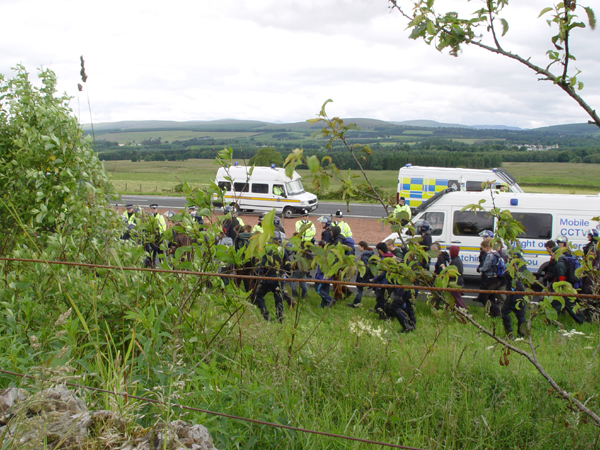
After some time, our group got pushed off the road. However, we quickly
realised that the police were unable or unwilling to leave the road and
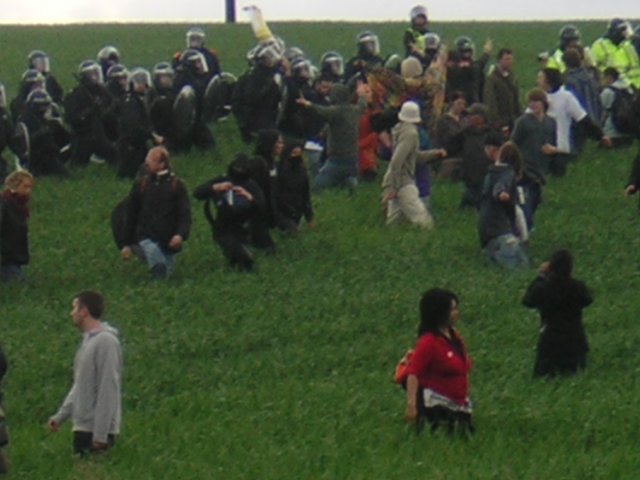
go into the fields. Before long, we had developed a simple strategy. We
would jump onto the road and block it, until the police were eventually
able to gather sufficient resources to get us off. Then, we would
quickly run off into the fields, walk to another point along the road,
and get back on. This completely confounded the police who spent the
whole day driving back and forth to blockade points which would simply
evaporate and reform somewhere else. As a result, we were able to hold
the A9 the entire day. From time to time, some traffic was able to get
through, but the safety of the road was so unpredictable that they were
virtually unable to send motorcades down it. There primary motorcade
route was down, and Scotland was completely cleaved in half.
Photos:
 http://www.indymedia.org.uk/images/2005/07/316627.jpg
http://www.indymedia.org.uk/images/2005/07/316589.jpg
http://www.indymedia.org.uk/images/2005/07/317213.jpg
http://www.indymedia.org.uk/en/2005/07/316733.html
M9 blockade
The M9 was chosen because it is a major artery to Gleneagles, and was
within easy walking distance of the ecovillage. But to get there, we
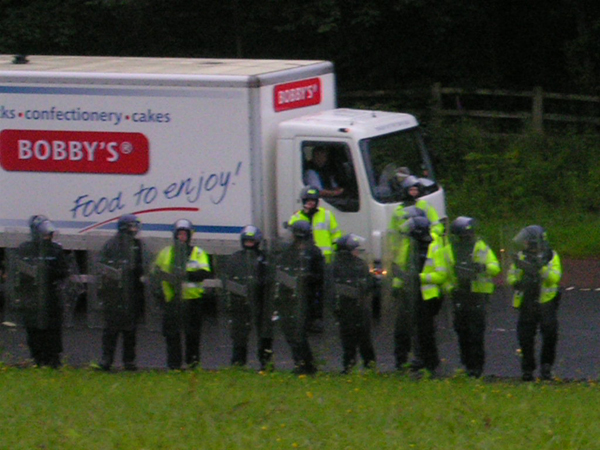
had to get through a cordon of about 50 police. Our plan was less than
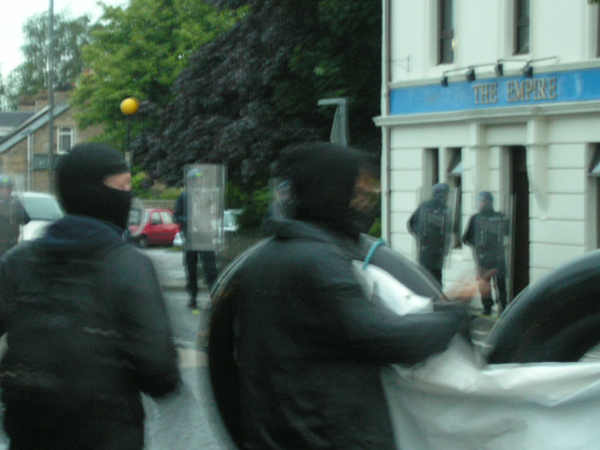
subtle -- we would go through them. Marching out at 3 a.m. we somehow
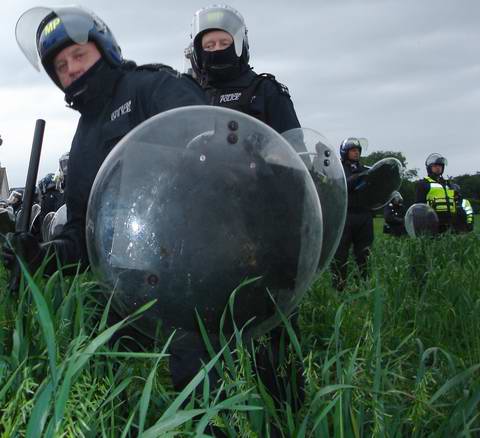
managed to catch them by surprise. We were dubbed the "suicide bloc",
and our method "the big stick plan". Those of us in front had padding
and big sticks, and beat them against the shields of the riot cops who
quickly retreated. Behind us, a group of Germans dressed in black
pushed two shopping carts of rocks, and threw them at the well armoured
police. "This is how we do things in Germany!" they explained to the
polite British amongst us.
We got through the cordon, and marched towards the M9 junction. The
police eventually managed to push us off our route and into a business
estate of chain stores. A car dealership, Bank of Scotland, Burger
King, Pizza Hut, and PC World proved too much of a temptation for some
in our group, and windows were smashed and the chain stores graffitied.
Media reported that homes and personal cars were attacked, but this was
not true.
People on bicycles scouted ahead to feed us information on police
positions, and eventually we got to the junction we were aiming for.
Later, we were met by others who had managed to get out of the
ecovillage. People marched through fields to evade the cops. Other
groups also took to the M9, including at various points a Samba band,
and a bike convoy. Playing cat and mouse with the police for the entire
day, we managing to keep the M9 shut.
Photos and video
http://www.indymedia.org.uk/en/2005/07/316629.html
http://www.indymedia.org.uk/en/2005/07/316639.html
http://www.indymedia.org.uk/images/2005/07/316937.jpg
http://www.indymedia.org.uk/images/2005/07/316938.jpg
http://www0.indymedia.org.uk/en/2005/07/317377.html
Full account of the suicide squad: http://www.counterpunch.org/tina07122005.html
Flying blockades...
Bike convoy
http://www.indymedia.org.uk/en/2005/07/316608.html
Car convoy
The car convoy managed to get out of the ecovillage after eventually
being stopped. They wound their way up and down the A9, traveling at
a crawl, and yelling "we love it when people block us in". Blockaders
were more than happy to oblige!
Kids protest
http://www.indymedia.org.uk/en/2005/07/317186.html
Affinity Group Blockades
The minor routes were taken by small "affinity groups" which had been
meeting in secret in the weeks leading up to the summit. Early in the
morning, we struck, focusing on locations close to where staff were
staying. We also blockaded the rail lines. Most of the blockades were
"hard", using tripods, locks, and sleeves. Cars were also used. The
first blockade to hit was the one at Crieff, where staff and American
delegates were staying. The first car we stopped was a group of
American delegates trying to get to the summit. Some of the affinity
blockades lasted the entire day, while a few were taken down in about
two hours.
Crieff blockade photo
http://carroll.org.uk/photos/d/137-2/IMG_7700.JPG?g2_GALLERYSID=6
515a27fd0256464a34287822c094dd7
Yetts o'Muckhart blockade photos
http://www.indymedia.org.uk/en/2005/07/317342.html
Edinburgh
Those in Edinburgh, based in the Jack Kane center, decided to blockade
the Sheraton hotel, where a number of delegates were staying. The
delegation from Japan ended up being delayed an additional half hour,
just to get out the hotel. While this blockade would turn out to be
small, it had the effect of creating a diversion, drawing most of the
police resources into the city. It also had the added bonus of forcing
Bob Geldof to switch hotels, from the Sheraton to the Balmoral.
Auchterarder
Due to the blockades, the situation was so ungovernable that police
initially canceled the G8 Alternatives march from Auchterarder. The
march organisers threatened to march anyway, and eventually the police
relented, although the march was delayed from noon, until 4:30, with
many people being turned back. Meanwhile, those who had been forced off
their blockades began walking to Gleneagles, and helped form a breakaway
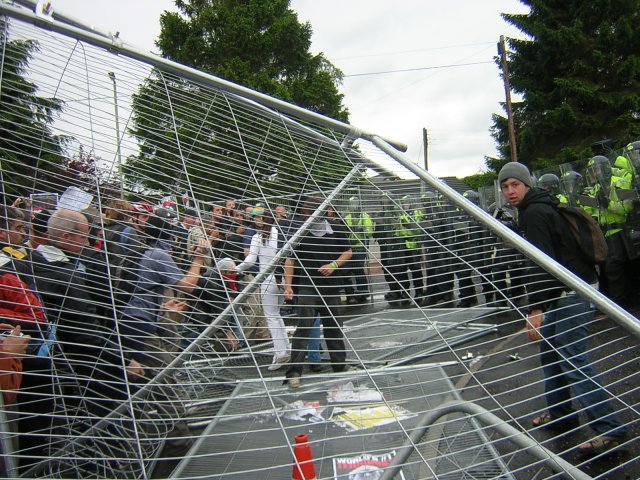
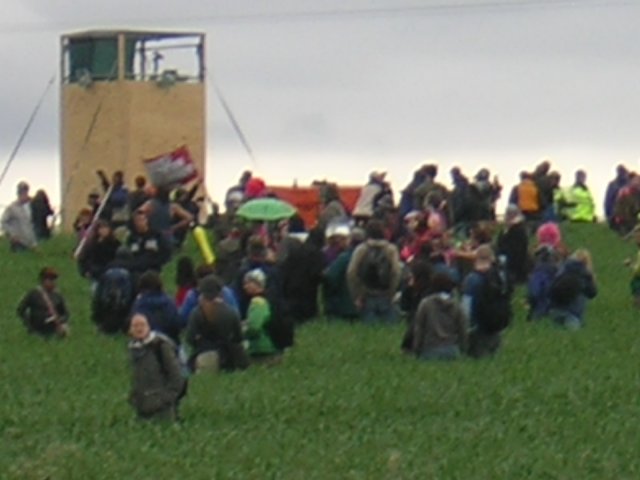
march, which walked towards the security fence and tore it down. Police
had to abandon their watch towers, and additional police had to be flown
in by Chinook helicopters.
http://www.indymedia.org.uk/images/2005/07/317058.jpg
http://www.indymedia.org.uk/images/2005/07/317057.jpg
http://www.indymedia.org.uk/images/2005/07/317086.jpg
http://www.indymedia.org.uk/images/2005/07/317088.jpg
http://www.indymedia.org.uk/images/2005/07/317089.jpg
Analysis
DIST ( http://www.tao.ca/~wrench/dist ) sent several blockade
experts to
the G8 to Analise tactics. These self-proclaimed revolutionary
consultants produced this guide
( http://www.tao.ca/~wrench/dist/badpress/blockade_guide.html )
and had the following few tips to aid in future blockades
- We estimated that over 4000 people took part in the G8 blockades
- Part of what made them so successful was the diverse nature of the
blockades, all of which were planned autonomously and often without
coordination. This made it impossible for the police to predict where
and when things would happen.
- The fact that so many people were willing to sleep in fields under
pouring rain, was inspiring.
- The disruption was massive, but people also came very close to
shutting down the summit entirely (except for the arrival of the
cowardly leaders who were flown in). Had a few improvements to the
blockades been made, or had the weather not been so bad, the shut-down
would have been total.
- The lack of solid communication links between the various blockades
did mean that it was impossible to reinforce blockades that went down.
It also meant that many people didn't know of the march to the security
fence around Gleneagles.
- The rain meant that many groups arrived wet and exhausted to the
blockades, and low on energy. The necessity of leaving the ecovillage
the day before was not communicated early enough to give people a chance
to properly prepare for such conditions. The inability to find a
convergence space for a longer period of time also meant that there was
not enough lead time for people to plan and prepare their blockades.
However, the fact that most people were together in the ecovillage,
meant that people could easily talk to each other, and work out tactics.
- While the informal nature of the plan meant the police had little idea
of what would happen, it also meant that many people had trouble tapping
into what was going on. More open communication of some of the plans
may have allowed more people to take part. Those who were not at
spokescouncils had little idea of what was happening, and additional
means of communication, especially with other convergence centers) would
have helped.
- The hit and run public blockades seemed to work more effectively
than the hard blockades of the affinity groups. More public blockades
along some of the more important secondary routes may have helped.
- People have the urge to sit in the middle of the road, or stand around
till they got penned in. Quell this urge. Running around, and moving
amongst stopped cars proved to be the most effective tactic. Running
into fields and back onto roads also worked well.
- While many took to the M9 because of it was close to the ecovillage,
other roads (A9, A822) were more strategically important, and should
have had more people.
- There were a ton of cars in the ecovillage. Bigger car and bike
convoys would have really fucked them up.
- Throw more shit in the road. Nothing pisses a riot cop off more than
having to drag branches and rocks around.
If you wish to add additional information or tips to this account,
please email wrench (at) tao.ca
We will update this text at
http://www.tao.ca/~wrench/dist/g8/2005/blockade_accounts.html
G8 Summit was so massive, that entire delegations canceled their
arrivals, or were delayed until the late afternoon. What follows is a
compilation of first person accounts of the day, and information from
inside sources. We also include some preliminary analysis of blockading
tactics. The site of the summit. the Gleneagles golf resort, was chosen
in the belief that its isolation would prevent effective protest. In
the end, its isolation proved a liability, as protesters emerged from
the surrounding forests and hills, forcing the police into unfamiliar
territory, and outmaneuvering them until the roads of Scotland were
paralyzed.
Protesters were spread over three convergence centers -- one in
Edinburgh, one in Glasgow, and a rural ecovillage close to Gleneagles.
While this made communication between us difficult, it also spread the
resources of the police to the breaking point. Due to massive
incompetence, the police were mistakenly convinced that Edinburgh would
be the focus of the blockades, and sent most of their forces there.
There decision appears to have been based on advice from the London
police force, whose personal obsession with some of the individuals
staying in the urban convergence spaces (members of the London-based
Wombles) made them blind to what everyone else was planning.
Those at the ecovillage planned to stage a number of blockades on the
roads surrounding Gleneagles. There were two public blockading
actions which had been proposed by different groups and consented to on by
the ecovillage spokescouncil -- a blockade of the A9 (the primary
motorcade route of the delegates and staff), and another of the M9, a
strategic point within walking distance of the ecovillage. A car convoy
and critical mass bike ride were to serve as flying blockades.
The big difficulty we faced was that the ecovillage was easy for the
police to seal off (all other previous site locations had fallen through
following pressure on landowners by the police). The A9 was also an
eight hour hike from the ecovillage. This didn't deter us. Groups had
to leave the ecovillage well before the blockades, due to go up the
morning of July 6th. On the morning of July 5th, small groups of people
dotted the ecovillage, sitting in circles around maps and planning their
blockades. Throughout the day, groups would approach the action
transport tent, and ask to get taken to their sleeping location. Others
just starting walking over the hills towards Gleneagles. As darkness
fell, most of the inhabitants of the ecovillage were scattered in the
hills and forests around Gleneagles. By the time the police realised
what was happening, it was too late. They set up a security cordon
around the camp on the evening of the 5th, but by then, we were already
in the hills.
A9 blockade
At midnight, beacons of dissent were lit on the top of two of the
tallest hills surrounding Gleneagles. Such fire beacons had been used
for centuries in Scotland as a warning of impending invasion. The
beacons strengthened the resolve of those of us who saw them. We had
been walking through the woods in pouring rain, slowly making our way
towards our blockade location. Overhead, helicopters would eerily
hover, some with massive search lights, and others with heat sensing
cameras. Each time one flew over, we would run under trees, and huddle
into a compact pile, so that the police wouldn't be able to count how
many of us there were.
We arrived close to our blockade point in time to catch an hour or two
of sleep. We were soaked by the rain, and cold, but we knew that
throughout the forest, there were other small groups just like ours,
waiting to take the motorcade route at dawn. At 7 a.m., we struck,
dragging branches onto the A9, and quickly forcing a line of cars and
trucks to a halt. We were a small group of around 40, but we were one
of many such groups all of whom took the A9 at a number of different
locations between the towns of Greenloaning and Blackford. The dispersed
nature of our blockade meant that the police had to be spread all along
the road, and due to the blockades, they had difficulty moving from one
location to the other.
After some time, our group got pushed off the road. However, we quickly
realised that the police were unable or unwilling to leave the road and
go into the fields. Before long, we had developed a simple strategy. We
would jump onto the road and block it, until the police were eventually
able to gather sufficient resources to get us off. Then, we would
quickly run off into the fields, walk to another point along the road,
and get back on. This completely confounded the police who spent the
whole day driving back and forth to blockade points which would simply
evaporate and reform somewhere else. As a result, we were able to hold
the A9 the entire day. From time to time, some traffic was able to get
through, but the safety of the road was so unpredictable that they were
virtually unable to send motorcades down it. There primary motorcade
route was down, and Scotland was completely cleaved in half.
Photos:
http://www.indymedia.org.uk/images/2005/07/316627.jpg http://www.indymedia.org.uk/images/2005/07/316589.jpg http://www.indymedia.org.uk/images/2005/07/317213.jpg http://www.indymedia.org.uk/en/2005/07/316733.html M9 blockade
The M9 was chosen because it is a major artery to Gleneagles, and was
within easy walking distance of the ecovillage. But to get there, we
had to get through a cordon of about 50 police. Our plan was less than
subtle -- we would go through them. Marching out at 3 a.m. we somehow
managed to catch them by surprise. We were dubbed the "suicide bloc",
and our method "the big stick plan". Those of us in front had padding
and big sticks, and beat them against the shields of the riot cops who
quickly retreated. Behind us, a group of Germans dressed in black
pushed two shopping carts of rocks, and threw them at the well armoured
police. "This is how we do things in Germany!" they explained to the
polite British amongst us.
We got through the cordon, and marched towards the M9 junction. The
police eventually managed to push us off our route and into a business
estate of chain stores. A car dealership, Bank of Scotland, Burger
King, Pizza Hut, and PC World proved too much of a temptation for some
in our group, and windows were smashed and the chain stores graffitied.
Media reported that homes and personal cars were attacked, but this was
not true.
People on bicycles scouted ahead to feed us information on police
positions, and eventually we got to the junction we were aiming for.
Later, we were met by others who had managed to get out of the
ecovillage. People marched through fields to evade the cops. Other
groups also took to the M9, including at various points a Samba band,
and a bike convoy. Playing cat and mouse with the police for the entire
day, we managing to keep the M9 shut.
Photos and video
http://www.indymedia.org.uk/en/2005/07/316629.html http://www.indymedia.org.uk/en/2005/07/316639.html http://www.indymedia.org.uk/images/2005/07/316937.jpg http://www.indymedia.org.uk/images/2005/07/316938.jpg http://www0.indymedia.org.uk/en/2005/07/317377.html Full account of the suicide squad:
http://www.counterpunch.org/tina07122005.html Flying blockades...
Bike convoy
http://www.indymedia.org.uk/en/2005/07/316608.html Car convoy
The car convoy managed to get out of the ecovillage after eventually
being stopped. They wound their way up and down the A9, traveling at
a crawl, and yelling "we love it when people block us in". Blockaders
were more than happy to oblige!
Kids protest
http://www.indymedia.org.uk/en/2005/07/317186.html Affinity Group Blockades
The minor routes were taken by small "affinity groups" which had been
meeting in secret in the weeks leading up to the summit. Early in the
morning, we struck, focusing on locations close to where staff were
staying. We also blockaded the rail lines. Most of the blockades were
"hard", using tripods, locks, and sleeves. Cars were also used. The
first blockade to hit was the one at Crieff, where staff and American
delegates were staying. The first car we stopped was a group of
American delegates trying to get to the summit. Some of the affinity
blockades lasted the entire day, while a few were taken down in about
two hours.
Crieff blockade photo
http://carroll.org.uk/photos/d/137-2/IMG_7700.JPG?g2_GALLERYSID=6 515a27fd0256464a34287822c094dd7
Yetts o'Muckhart blockade photos
http://www.indymedia.org.uk/en/2005/07/317342.html Edinburgh
Those in Edinburgh, based in the Jack Kane center, decided to blockade
the Sheraton hotel, where a number of delegates were staying. The
delegation from Japan ended up being delayed an additional half hour,
just to get out the hotel. While this blockade would turn out to be
small, it had the effect of creating a diversion, drawing most of the
police resources into the city. It also had the added bonus of forcing
Bob Geldof to switch hotels, from the Sheraton to the Balmoral.
Auchterarder
Due to the blockades, the situation was so ungovernable that police
initially canceled the G8 Alternatives march from Auchterarder. The
march organisers threatened to march anyway, and eventually the police
relented, although the march was delayed from noon, until 4:30, with
many people being turned back. Meanwhile, those who had been forced off
their blockades began walking to Gleneagles, and helped form a breakaway
march, which walked towards the security fence and tore it down. Police
had to abandon their watch towers, and additional police had to be flown
in by Chinook helicopters.
http://www.indymedia.org.uk/images/2005/07/317058.jpg http://www.indymedia.org.uk/images/2005/07/317057.jpg http://www.indymedia.org.uk/images/2005/07/317086.jpg http://www.indymedia.org.uk/images/2005/07/317088.jpg http://www.indymedia.org.uk/images/2005/07/317089.jpg Analysis
DIST (
http://www.tao.ca/~wrench/dist ) sent several blockade experts to
the G8 to Analise tactics. These self-proclaimed revolutionary
consultants produced this guide
(
http://www.tao.ca/~wrench/dist/badpress/blockade_guide.html ) and had the following few tips to aid in future blockades
- We estimated that over 4000 people took part in the G8 blockades
- Part of what made them so successful was the diverse nature of the
blockades, all of which were planned autonomously and often without
coordination. This made it impossible for the police to predict where
and when things would happen.
- The fact that so many people were willing to sleep in fields under
pouring rain, was inspiring.
- The disruption was massive, but people also came very close to
shutting down the summit entirely (except for the arrival of the
cowardly leaders who were flown in). Had a few improvements to the
blockades been made, or had the weather not been so bad, the shut-down
would have been total.
- The lack of solid communication links between the various blockades
did mean that it was impossible to reinforce blockades that went down.
It also meant that many people didn't know of the march to the security
fence around Gleneagles.
- The rain meant that many groups arrived wet and exhausted to the
blockades, and low on energy. The necessity of leaving the ecovillage
the day before was not communicated early enough to give people a chance
to properly prepare for such conditions. The inability to find a
convergence space for a longer period of time also meant that there was
not enough lead time for people to plan and prepare their blockades.
However, the fact that most people were together in the ecovillage,
meant that people could easily talk to each other, and work out tactics.
- While the informal nature of the plan meant the police had little idea
of what would happen, it also meant that many people had trouble tapping
into what was going on. More open communication of some of the plans
may have allowed more people to take part. Those who were not at
spokescouncils had little idea of what was happening, and additional
means of communication, especially with other convergence centers) would
have helped.
- The hit and run public blockades seemed to work more effectively
than the hard blockades of the affinity groups. More public blockades
along some of the more important secondary routes may have helped.
- People have the urge to sit in the middle of the road, or stand around
till they got penned in. Quell this urge. Running around, and moving
amongst stopped cars proved to be the most effective tactic. Running
into fields and back onto roads also worked well.
- While many took to the M9 because of it was close to the ecovillage,
other roads (A9, A822) were more strategically important, and should
have had more people.
- There were a ton of cars in the ecovillage. Bigger car and bike
convoys would have really fucked them up.
- Throw more shit in the road. Nothing pisses a riot cop off more than
having to drag branches and rocks around.
If you wish to add additional information or tips to this account,
please email wrench (at) tao.ca
We will update this text at
http://www.tao.ca/~wrench/dist/g8/2005/blockade_accounts.html
rask










Comments
Display the following 2 comments