Palestinian al-Nakbah at 60: the case of unrecognized villages
Sharat G. Lin | 16.05.2008 17:07 | History | Palestine | Repression | World
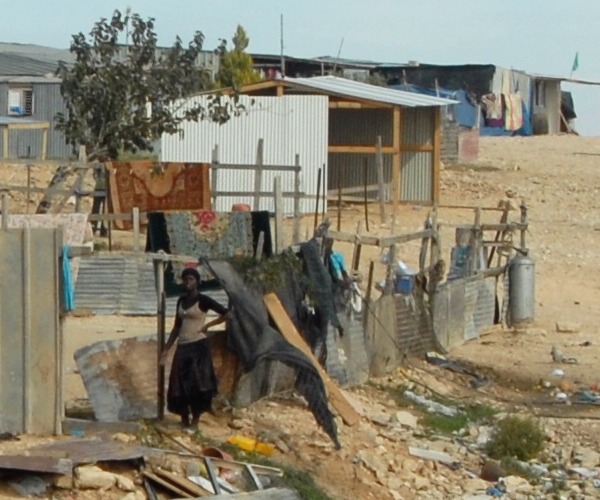
Bedouin woman outside her home in Qiryeh al-Sir
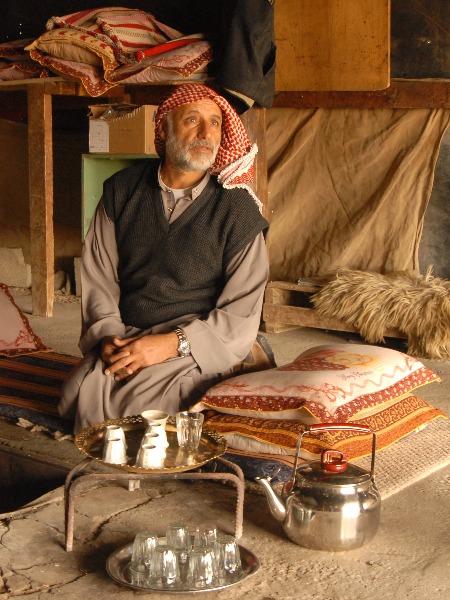
Sheikh Ibrahim
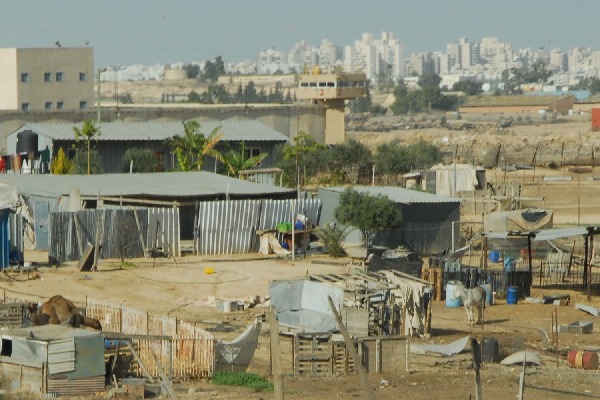
Unrecognized Bedouin settlement in the shadow of Be'er Sheva prison and highrise
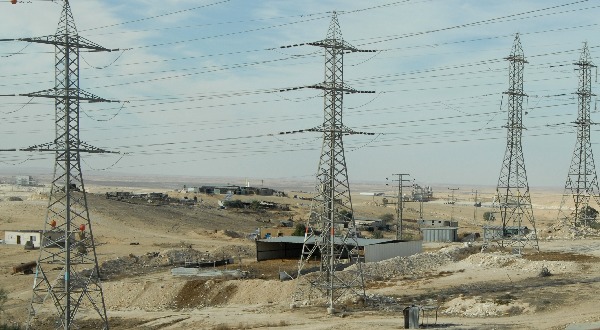
Bedouin houses under high voltage transmission lines receive no electricity
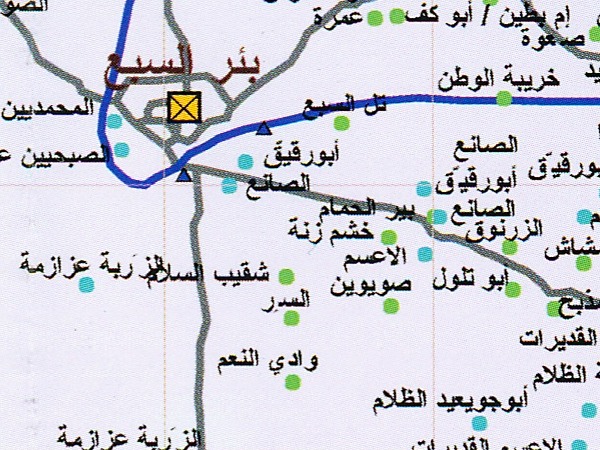
Be'er Sheva area: demolished villages (blue dots), unrecognized villages (green)
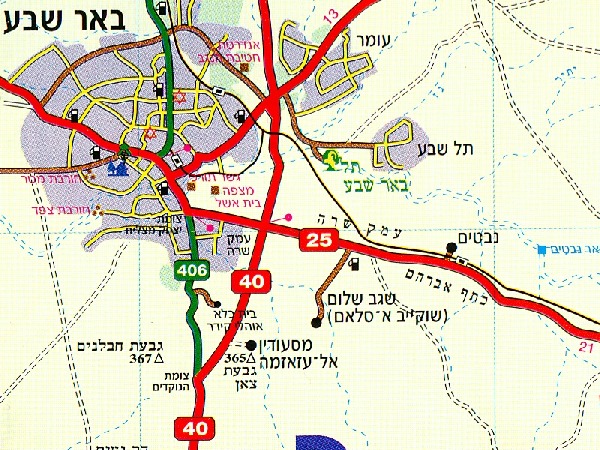
Israeli map of Be'er Sheva area: unrecognized inhabited villages "do not exist"
This story of a Palestinian village in the Negev is a perspective on al-Nakbah (النكبة) at the age of 60.
Sheikh Ibrahim is the leader of the Palestinian village of Qiryeh al-Sir (قريۃ السير) just beyond the outskirts of Be'er Sheva, Israel's fourth largest and fastest growing city. His red kafiyeh is traditional among Bedouins in the Negev, Jordan, and the Arabian peninsula. But most Palestinian Bedouins have long since given up on a former nomadic lifestyle and have taken up permanent residence in spread-out impoverished villages.
Sipping a cup of Arabic tea on the carpeted earthen floor of his tent, the Sheikh recalls how 90 per cent of Bedouins were evacuated from the Negev to Jordan in 1948 as part of al-Nakbah. In 1953, Israel imposed military rule in the Negev, he says. Had the remaining Bedouins not abandoned their once nomadic lifestyle, they too would have been expelled, losing their claims to their houses and fixed lands under military occupation. Even then, they resisted expulsion under threats of death. Those who fled and later tried to return to their pre-1948 settlements were killed, he said.
Sheikh Ibrahim complains that 21 Palestinian houses were demolished here just the week before this interview. Israel never offered land for legal settlement in Qiryeh al-Sir, which has a population of 4000. While Israel strictly prohibits Palestinians from digging water wells, it never offered to provide a water connection to the village. Only after years of struggle, the village finally negotiated a supply of water from an industrial pipeline that runs through the village.
In fact, the State of Israel provides Qiryeh al-Sir with no roads, no sewage, no schools, and no social services. Even though a thermal power plant was built in the midst of the village and a myriad of high voltage transmission lines tower above its houses, Qiryeh al-Sir receives none of that electricity. Instead villagers must use generators to supply their electricity needs. This is despite the fact that residents pay all Israeli taxes, except property tax since the Israeli government does not recognize Bedouin claims to the land. In contrast, Jewish settlers -- many arriving for the first time directly from foreign countries -- are provided will all services and leasehold titles before they even move in, Sheikh Ibrahim laments.
In Ottoman times, Bedouins used to move from hill to hill, grazing their flocks, within territorial limits that were registered by the Ottoman administrators. But Israel has persistently refused to recognize Ottoman and British land titles, even when presented with written documents. The only pre-Israeli land titles recognized are those issued by Jordan during its administration of the West Bank from 1949 to 1967.
Why? Because Qiryeh al-Sir is one of scores of "unrecognized villages" that the State of Israel wants vacated by moving all Bedouins into five recognized Palestinian towns in the Negev. The reason is basic. Bedouin villages, though relatively sparsely populated, sprawl over vast tracts of land. The Israeli government wants the land for future Jewish settlements and desert agriculture. Therefore, it wants to concentrate all Palestinian Bedouins into five compact recognized towns by providing full services to lure them.
One such recognized town is Shqeeb al-Salaam (شقيب السلام) whose houses and shops look much like any modern Palestinian town in the West Bank. Unlike the unrecognized villages, there are paved roads, streetlights, schools, shopping centres, and petrol stations, but no tents, few animal sheds, and not much land in between the buildings.
There are estimated to be 160,000 Palestinian Bedouins living in the Negev. Some 80 per cent live in 53 unrecognized villages. As residents within Israel's pre-1967 borders, they were granted Israeli citizenship in the 1970s on the condition that they join the Israeli Defence Forces (IDF), yet they enjoy few of the rights and privileges of citizenship on their ancestral lands. Thousands of additional Bedouins live in small unrecognized villages scattered in the Judean Desert of the West Bank.
Economically, they are also second class citizens. Privately-owned factories only hire Bedouins to do cleaning jobs, explains Sheikh Ibrahim. But even those jobs are increasingly being given to Ethiopian or Russian Jewish immigrants. That explains the makeshift sheds that many villagers live in. It is an increasingly hard life in a modern industrially-advanced society.
It is fitting to ask whether al-Nakbah could be repeated, whether in the name of fighting "terrorism" or in the name of Eretz Yisrael (the land of greater Israel). In the Negev today, the systematic and deliberate expulsion of Palestinian Bedouins from their traditional homes is a slow process. Once in a while, a handful of houses are administratively selected for demolition, thus attempting to isolate individual families and divide the community. But at the current rate, if it took 60 years to expel 20 per cent of the Bedouin population, it will take another 240 years to expel all of them. The remaining residents of Qiryeh al-Sir are determined to resist displacement, Sheikh Ibrahim insists. For the Bedouins of the Negev, al-Nakbah, albeit slowly, has never ended.
Sharat G. Lin writes on global political economy, the Middle East, India, and the environment. He has spent many years in the Middle East, including Lebanon, Israel-Palestine, and the Arab Gulf countries. He is affiliated with the San Jose Peace and Justice Center.
Sharat G. Lin






