Protest Mediators: A Plan To Make Protest Even More Benign
Keith Farnish | 03.08.2009 07:49 | G20 London Summit | Analysis | Other Press | Repression | South Coast
What is the point of protest?
To create change. I would have thought that was obvious; it is the only rational response to the question. So why has so little change happened as a result of protest in the Western world in the last 30 years?
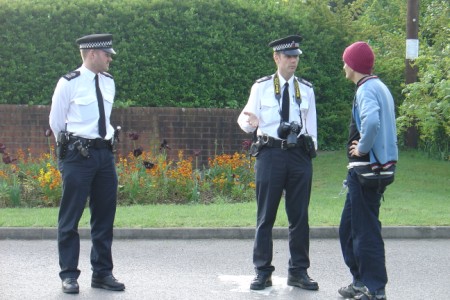
This is obvious, too: because the activities that masquerade as “protest” in the modern age, have as little to do with protest as a Toyota Prius has to do with environmental sustainability. The vast majority of “protests” organised by groups such as Greenpeace, the Sierra Club and Friends of the Earth, are simply expressions of feeling; they are not even expressions of intent, because it is clear that there is no intention of going further than marching up and down the street, waving banners and placards, shouting slogans, beating drums and singing sings.
As I wrote in A Matter Of Scale [
 http://www.amatterofscale.com]:
 "So, go and protest, make some noise, wave some banners, sign a petition: just make sure you stay within the law. I mean it – protest of some form or another is permitted in most nations, but the severity and the type of protest allowed depends on the legislation that is in place; both standing legislation and the widely used “state of emergency” which, in fact is simply an extension of the existing laws. As the Zimbabweans ponder their electoral fate, the Mugabe regime has imposed “emergency” laws to prevent any form of gathering that may threaten the government. What the Mugabe regime knows only too well is that in Zimbabwe, as with many other African, South American and Asian states, protest often takes an entirely different form to the type of protest the people of the industrial West have become accustomed too. The Mugabe regime know that real protest is capable of overthrowing governments; whereas in the USA, for instance, it almost goes without saying that protest will lead to nothing more than a warm feeling in the hearts of those taking part…The laws in each country are tailored to suit the appetite of the population for change: a country full of people that want to fight for change needs to be kept tightly controlled; a country full of catatonic, drip-fed consumers can march all they like, be given a well-controlled soapbox on TV – and the voltage on the tasers can be turned right down."
As with any mass gathering of people, there will be friction between those on one side and those on the other, and in the case of the G20 marches and sit-ins, there were a number of inexcusable events that took place, including one death...
http://www.youtube.com/watch?v=HECMVdl-9SQ On the “protestors’” side, there were also a number of inexcusable activities, at least equal in quantity to the number of people who went along to the event thinking that by marching peacefully, they would make any difference at all. Of course they wouldn’t, and it is with this in mind that the UK Parliamentary Joint Committee on Human Rights [
http://www.parliament.uk/parliamentary_committees/joint_committee_on_human_rights.cfm] have decided to take advantage of the submissiveness of mainstream environmental and human rights groups (the ones who organise such “protests”) and proposed that a system of Objective Mediation be set up, ostensibly to protect the human rights of people taking part in such events. "Independent Northern Ireland-style go-betweens could ease tensions between police and protesters, say MPs.
"The Joint Committee on Human Rights said poor communications lay at the heart of problems at the G20 protests on 1 April.
"Its report says a decision to “kettle” some of the London demonstrators had failed to recognise their rights.
"The Metropolitan Police said it learned lessons from G20 and was committed to working with all protest groups.
"One man died after the London protests and investigators are looking at other formal complaints about police actions.
"The committee said there was a “long way to go” before police put human rights at the core of their planning and live operations.
"In its review of the G20 protests, the MPs and peers argued that the Metropolitan Police became heavy-handed after a lack of communication between the two sides.
" “Both protesters and police must share information,” said the report. “Whilst this happens in many cases it is clear that at least some aspects of communication at the G20 protests were poor.
" “Mutual distrust was apparent and the police and protesters seemed to have different expectations of what the dialogue should be about and how it should proceed.
" “This ineffective communication led to frustration on both sides and, possibly, to the police taking a more heavy handed approach to the Climate Camp protest than would otherwise have been the case.” "
(BBC News :
http://news.bbc.co.uk/1/hi/uk/8171516.stm) It will come as no surprise that the real reason for such “mediation” is simply to further dilute the already benign nature of public protest. As Ward Churchill states in Pacifism As Pathology [
http://books.google.co.uk/books?id=gFvCpJj-iP0C]: "One will find hundreds, sometimes thousands, assembled in an orderly fashion, listening to selected speakers calling for an end to this or that aspect of lethal state activity, carrying signs “demanding” the same thing…and – typically – the whole thing is quietly disbanded with exhortations to the assembled to “keep working” on the matter and to please sign a petition.
"Throughout the whole charade it will be noticed that the state is represented by a uniformed police presence keeping a discreet distance and not interfering with the activities. And why should they? The organizers will have gone through “proper channels” to obtain permits. Surrounding the larger mass of demonstrators can be seen others…their function is to ensure the demonstrators remain “responsible,” not deviating from the state-sanctioned plan of protest"
Set up a mediation system, and those running the “protest” have even more control over their charges by virtue of their elite status as official communicators with the mediators. Set up a mediation system, and the police have even more information which which they can micromanage the events as they unfold. Set up a mediation system and “protest” becomes little more than a state-sponsored media spectacle which threatens nothing, and leads to no change whatsoever.
Real protest doesn’t unfold according to a pre-agreed agenda; real protest is illegal; *real protest creates change*. The gulf between symbolic and non-symbolic action is widening as I write — it may be your last chance to jump over to the side which is actually going to achieve something.
Keith Farnish
 Homepage:
http://www.unsuitablog.com
Homepage:
http://www.unsuitablog.com







Comments
Display the following 6 comments